LED Stadium Lighting Documentation for Metal Halide Retrofit Tenders and Global Projects
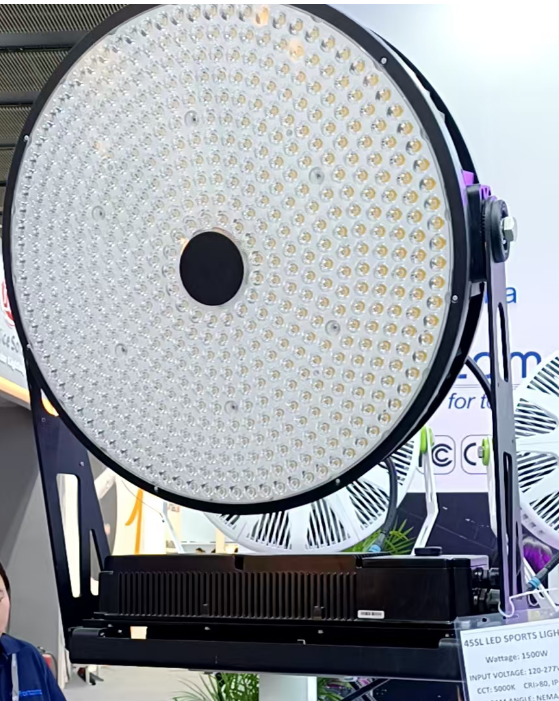
When upgrading stadiums from Metal Halide to LED, tender documents need to demonstrate more than fixture wattage. Contractors, distributors, and project developers may require product specifications, photometric information, certifications, control details, warranty terms, and installation data before selecting an LED high mast lighting system.
Documentation for LED Stadium Lighting Tenders
A complete LED stadium lighting tender package typically includes a product datasheet, technical specifications, photometric files, certification documents, driver information, warranty details, and installation information.
For large stadiums and high-mast sports facilities, the lighting documentation should also clearly identify power output, lumen performance, beam angles, operating temperature, IP rating, surge protection, and available controls.
45SL High Mast LED Light for Metal Halide Retrofit
The FORTOMO 45SL is a 1500W high mast LED sports light designed for large outdoor applications. It delivers up to 220,000 lumens with a luminous efficacy of 150–170 lm/W , providing a high-output solution for stadiums, sports grounds, and other large-area lighting projects.
The 45SL supports NEMA2, NEMA3, NEMA4 and NEMA6 distributions, with 15°, 25°, 35°, and 45° beam angles . This allows lighting designers to select optics according to pole height, field dimensions, and fixture positioning during a Metal Halide to LED stadium retrofit .
Key Technical Information for Project Submittals
The 45SL provides the technical specifications required for international project evaluation:
- 1500W power
- Up to 220,000 lm output
- 150–170 lm/W efficacy
- NEMA2/3/4/6 and 15°–45° beam options
- IP66 protection
- 10kV/20kV optional surge protection
- 100,000-hour rated life
- 100–277VAC input
- 3000K–6000K CCT and optional RGBW
- 0–10V, PWM, DALI, DMX512 and Synapse controls
- Operating temperature of -40°C to +45°C
- 5-, 7-, and 10-year warranty options
The fixture uses high-conductivity pure aluminium for thermal management, an anti-corrosion powder coating process, tempered glass lenses, and a constant-current LED driver. Its low EPA design is also intended to withstand high wind conditions, which is relevant for high-mast installations.
Certifications for Global LED Lighting Projects
The 45SL product page lists UL, ETL, SAA, SPE, BIS, SASO, and CB certification options. The exact certification and documentation supplied should be confirmed according to the product configuration and destination-market requirements.
For global tender submissions, buyers can request the relevant technical datasheet, certification documents, photometric files, driver specifications, and warranty information as part of the project submittal package.
Supporting Metal Halide Stadium Upgrades
A professional LED stadium lighting retrofit tender should evaluate lighting performance together with documentation and compliance requirements. High-output fixtures such as the 45SL can provide a flexible platform for replacing high-power Metal Halide systems while allowing designers to select suitable optics and controls for different stadium layouts.
For international contractors, distributors, and sports lighting project developers, the 45SL provides a documented 1500W LED high mast lighting solution for large stadiums, sports grounds, and other high-mast retrofit projects worldwide.